
Too Close to Home

The Adviser’s Dilemma
A monthly column where Emma unpacks real-life situations from across the profession and shares a fresh perspective.
Each month you'll find the latest column published here and also featured in Money Marketing Magazine.
To submit a question anonymously click here
Dear Emma,
I’ve been working as a financial planner for several years now. I love my job and think I’m good at it. But there is one aspect of the role I know I could handle better.
I’m quite an emotional person, and I can find it difficult when clients become distressed. This happens often, particularly because former clients frequently recommend me to people going through divorce.
Recently, for example I met a client whose mother had died unexpectedly. She went into hospital with something minor, developed pneumonia and never came home. Likely because my Mother died in similar circumstances when I was at University; though I managed to hold myself together during the meeting, inside I felt completely floored. I became stilted and awkward, trying to fight back tears, and I’m sure my client noticed.
I know I should be more professional and better able to detach from my emotions. And at the same time I worry that I’m not being very sympathetic to clients because so much of my energy is being spent trying to hold it together. What do you think?
Yours,
Too Close to Home
Dear Too Close to Home,
Thank you for writing so honestly. I was moved by your letter.
My first instinct is to reassure you that you have not done anything wrong. You lost your Mother in traumatic circumstances at a young age and it sounds as if your grief was activated by the similarity in your shared stories with this particular client. It’s completely understandable and perhaps even inevitable.
But I recognise your question is a broader one than just this one client. I think you’re asking how to remain composed and professional when also feeling emotionally triggered?
I don’t think the aim is to detach from your feelings in a bid to be more professional as your letter suggests. Rather I think the aim is to build your self awareness and capacity to self regulate so that you can be authentic - feelings and all - AND remain boundaried. The key is to remember that emotional responses, when handled with awareness, can be usefully expressed and that this can actually be in the service of your client and your shared relationship.
For example in a similar situation, you might say, “I feel moved by what you’re telling me.” You might even add, “I lost my mother in similar circumstances, so this has touched me personally.”
The purpose would be to name what was already present, and allow you to then return the focus to your client without expending so much energy trying to suppress your emotional response. A thoughtful disclosure can often build trust and help you regulate because you are no longer swallowing down or fighting back what you feel. The important thing is that you are not disclosing in order to process your feelings with your client or and not asking for your client to support you.
Clients often notice when something changes in us. The risk is that without a transparent explanation, your client might have interpreted your holding on to your feelings as disinterest or a signal that their feelings were unwelcome. Naming your response could have helped them understand that you were affected because you were resonating with them and their story.
I have a few options you might want to consider:
Finding some professional support for the relational dimensions of your role, helping you to separate out what’s yours from what’s your clients and thinking around how to find that balance between empathy, authenticity and professionalism. I think this capacity and clarity is earned through reflection, discussion and feedback with others or with a mentor/coach. Perhaps you could form a reflective practice group with colleagues whom you trust? Or you could find a coach/mentor to work with on a 1:1 basis. Or you might want to join an established peer group with other financial professionals.
Working with a therapist. Having someone trusted and supportive to talk through how you’re feeling might really help. It will support you to build your capacity to self regulate so that you feel less ambushed by your emotions.
You might also consider more focused training in the emotional and relational dimensions of your role as a planner. This could help you develop the skills to remain empathic and emotionally connected in the service of your client, while also feeling regulated and appropriately boundaried. I remain exasperated that this does not form part of the core training required to become a financial planner, because I believe it is so clearly needed.
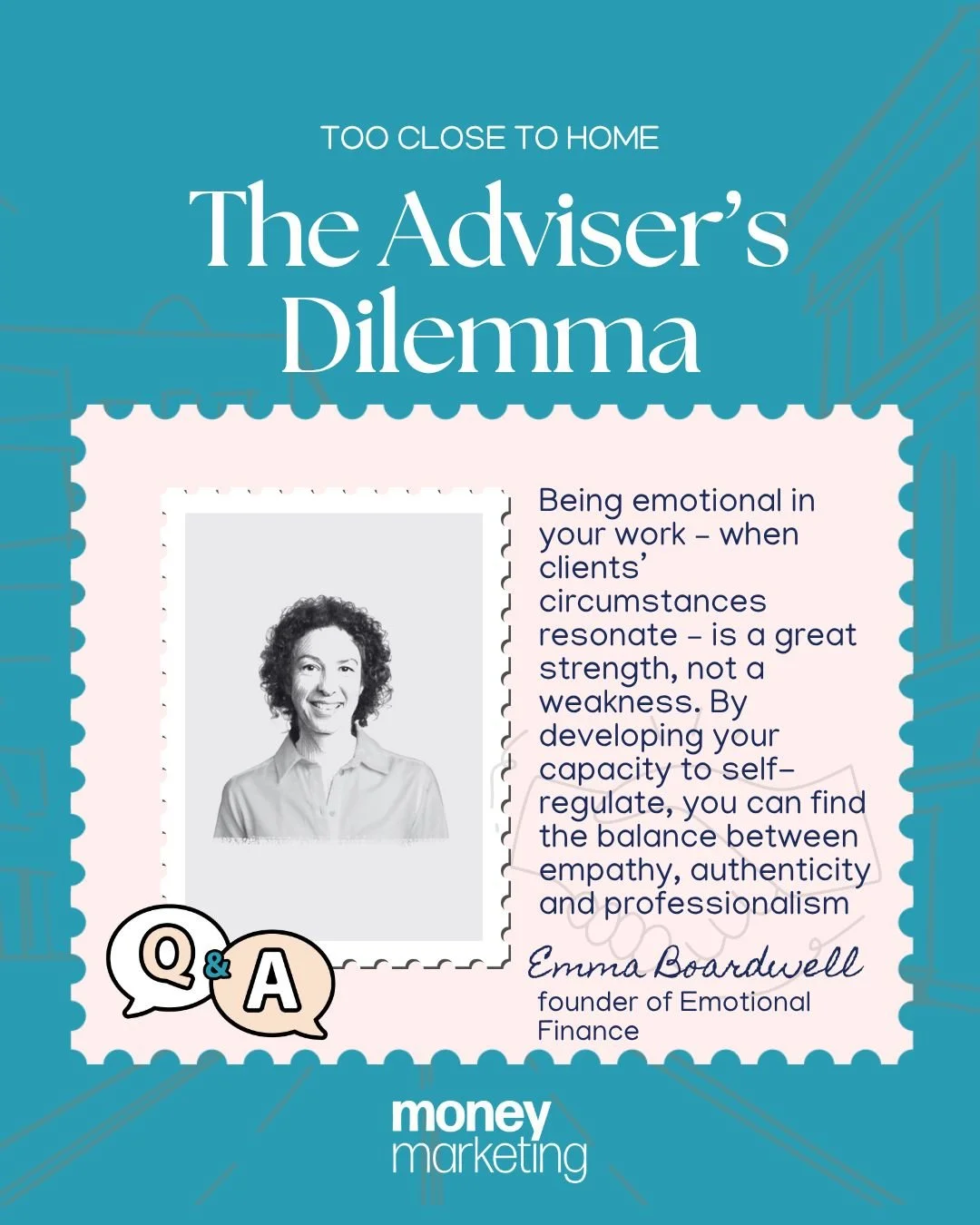
Finally, I want to end my response with a reassurance that being emotional in your work is not a weakness to overcome. It is rather a great strength that needs to be approached with care, self awareness and sufficient support. Your clients are lucky to have you.
Warmly,
Emma
If you’d like to send us your dilemma or read more from others - head to the submissions page, and/or sign up to the newsletter to be informed when the latest column is published.