
September Open Cohort Now Enrolling
//
Save £350 if you join before June 30th
//
September Open Cohort Now Enrolling // Save £350 if you join before June 30th //
The Emotional Finance Programme
If you're building a team in the financial services space, you've probably invested heavily in technical development - qualifications, product knowledge, supervision.
But you’ll also likely recognise that those who thrive, share something that doesn't appear on any technical qualification syllabus:
They know how to build relationships that clients value.
Unfortunately, most firms leave this human dimension of the role to chance. They rely on inclination, instinct and shadowing; assuming that emotional literacy and relational intelligence develop over time, informally and implicitly with no framework, no reflective practice and no shared language.
At Emotional Finance, we believe that relationships need to be approached with the same rigour as the technical aspects of the role. We believe that skills need to be cultivated with consistency; and that the value professionals bring to their relationships needs to be made tangible and explicit.
And we believe that financial professionals deserve to be supported to do this well right from the outset - not left to figure it out alone.
The Emotional Finance Programme is how we do that.

Programme Outcomes:
Our flagship training gives advisers a systematic framework for relationships themselves. By the end of the programme, participants will be able to:
Understand the difference between well-intentioned and well-executed relationships, and why that distinction matters for client and business outcomes
Deepen their knowledge of how emotional and relationship dynamics shape client and business outcomes
Extend their emotional range whilst maintaining clear and confident professional boundaries and avoiding role-creep
Ensure that their clients can see, feel and articulate the value of the relationships they build together
Use the Emotional Finance Model as a framework upon which to build their own authentic style of practice, stretching far beyond technical competence
Leave with frameworks, tools, and language they can use immediately to improve client conversion, retention, engagement and recommendations
This programme is for:
The Emotional Finance Programme is designed for early-career client-facing financial professionals; ideally those already working directly with clients, or shadowing senior colleagues with a view to building their own client relationships in the short term.
How the Programme Works:
The programme works at three layers of learning:
Theoretical - a psychotherapeutically informed model gives you the framework to understand
Practical - the skills, insights and tools to apply the theory and translate that understanding into a deliberate and repeatable approach
Experiential - role-plays, client scenarios, debriefs and direct feedback to embed the learning in conditions that mirror the complexity of real client work
The Syllabus:
-
The foundational layer of all relationships. Topics include:
Understanding what trust actually is
Signals of trust
Trust in the context of Financial Services
Exploring and demonstrating benevolence
Integrity - and how it differs from ethics and regulation
The three layers of transparency
Building the different dimensions of competence
-
Emotional literacy and relational intelligence in action (Part 1) Topics include:
Understanding and cultivating presence
Managing distractions (internal and external)
Exploring contact styles
Introduction to dialogue
Listening to understand
Pacing, permission, depth in conversation
Managing interrupting and silence
The practice of shuttling attention
-
Deepening emotional literacy and relational intelligence Topics include:
Understanding practicing empathy
Asking curious Questions
Working with different question styles
Reflecting and Summarising Skills
Bracketing Assumptions
Demonstrating boundaried authenticity
Navigating Heightened Emotions
-
Building a working alliance. Topics include:
Co-creation and what it means in practice
Expert vs Collaborator stances
Working in the service of clients
Balancing support and challenge
Building a reflective Practice

Register for the Emotional Finance Programme
To register for a place on the Emotional Finance Programme, please complete the form below:
You have 2 payment options:
For bookings made on or before 3 August 2026. you may secure your place with a deposit of £250. The remaining balance of £1,725 will be due by 3 August 2026.
For bookings made after 3 August 2026, payment is required in full at the time of booking
Once your form has been submitted, we will issue an invoice for payment.
When payment has been received, the participant will receive confirmation of their place along with joining instructions to the programme.
By submitting this form, you confirm that you have read and agree to our Terms & Conditions.
Not ready to register, but interested in knowing more?
If you’d like to register your interest and be kept in the loop for September’s or for future cohorts, please complete this form, or schedule a call with me.
Programme Structure and Pricing:
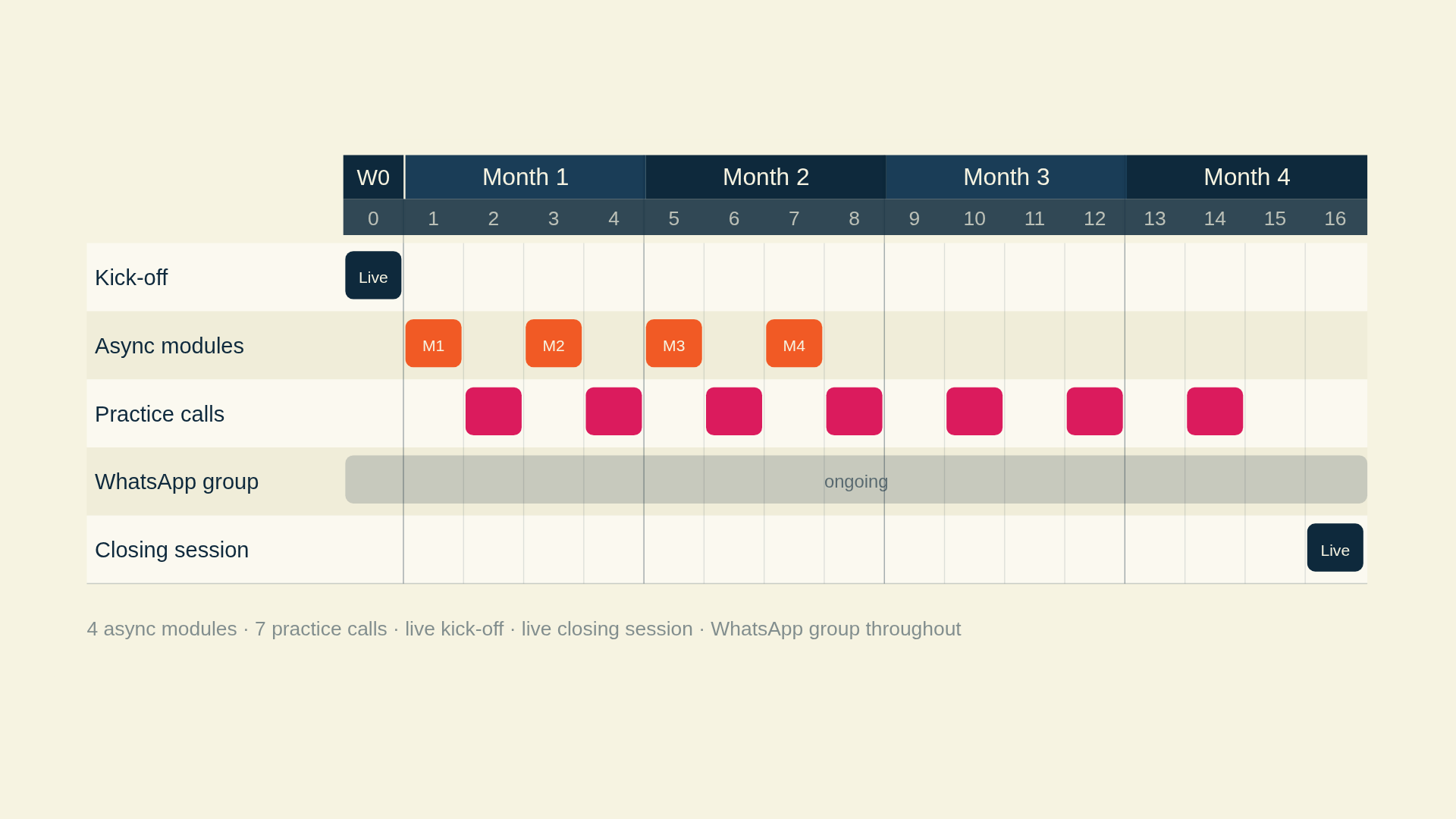
The Emotional Finance Programme runs over four months because we believe that's the time that real change takes to embed.
The structure is designed to support the full cycle of learning, reflection and growth; to allow time to try things with real clients, notice what happens, bring it back to the group, and go again.
Months 1 and 2 are training-intensive with four training modules front-loaded alongside fortnightly practice calls. The second phase shifts to fortnightly practice calls through Months 3 and 4, which is where the work really begins to stick.
What’s Included:
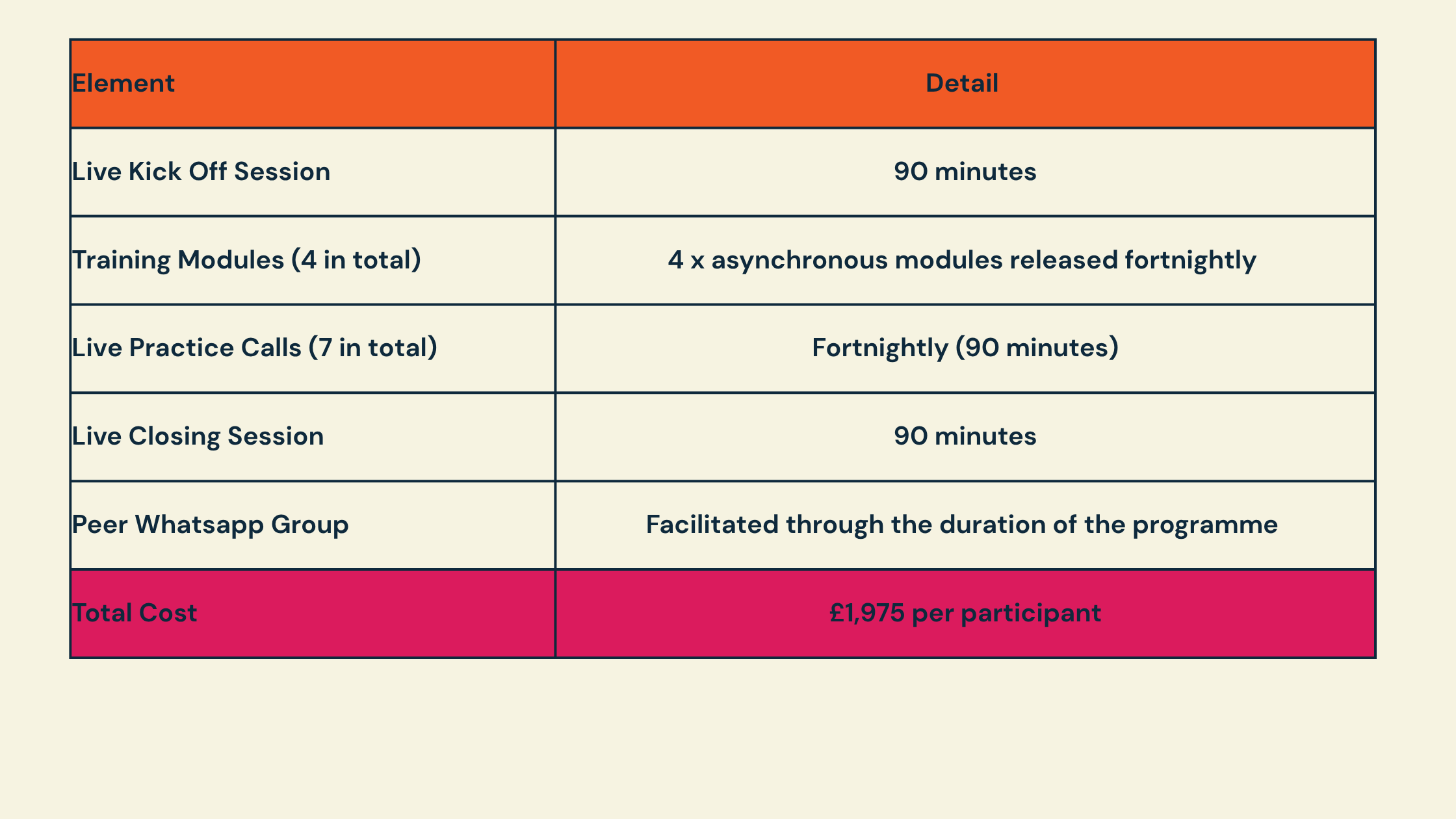
1 × Kick-off session (90 minutes) - intake survey, welcome, benchmarking assessment, and orientation to the programme
4 × Asynchronous training modules - released fortnightly from week one, so you can engage with the material on your own schedule - without it competing with your client diary
7 × Live practice calls (90 minutes each) - scheduled fortnightly throughout the programme. These are active, participatory sessions: role-plays, client scenarios, debriefs, and direct feedback. All practice calls are recorded and available in the programme portal, so you won’t miss out if you can’t make it live.
Facilitated Peer WhatsApp group - open throughout the programme for questions, reflections, resource-sharing, and celebrating progress. A community of practitioners navigating the learning together.
1 × Live Closing session (90 minutes) - post-programme benchmarking, shared and individual reflections, personal goal-setting for what comes next
Programme Options:
The Emotional Finance Programme can be delivered in two ways:
In-house for firms who want to run the programme exclusively for their own team, with cohorts of between six and ten participants.
Open cohorts for individual practitioners or smaller firms, joining a cohort of between six and ten participants across different firms and organisations
Both follow the same 16-week structure and include the full programme content.
Investment:
The full cost of the programme is £1,975 per participant which includes:
This cost does not include the following, which are available as optional extras:
One-to-one coaching or mentoring with individual participants
Relational File Checks - where Emma listens to client meeting recordings and provides direct, individual feedback
Bespoke reporting beyond aggregated benchmarking scores
Pricing for optional extras is available on request.
The Impact:
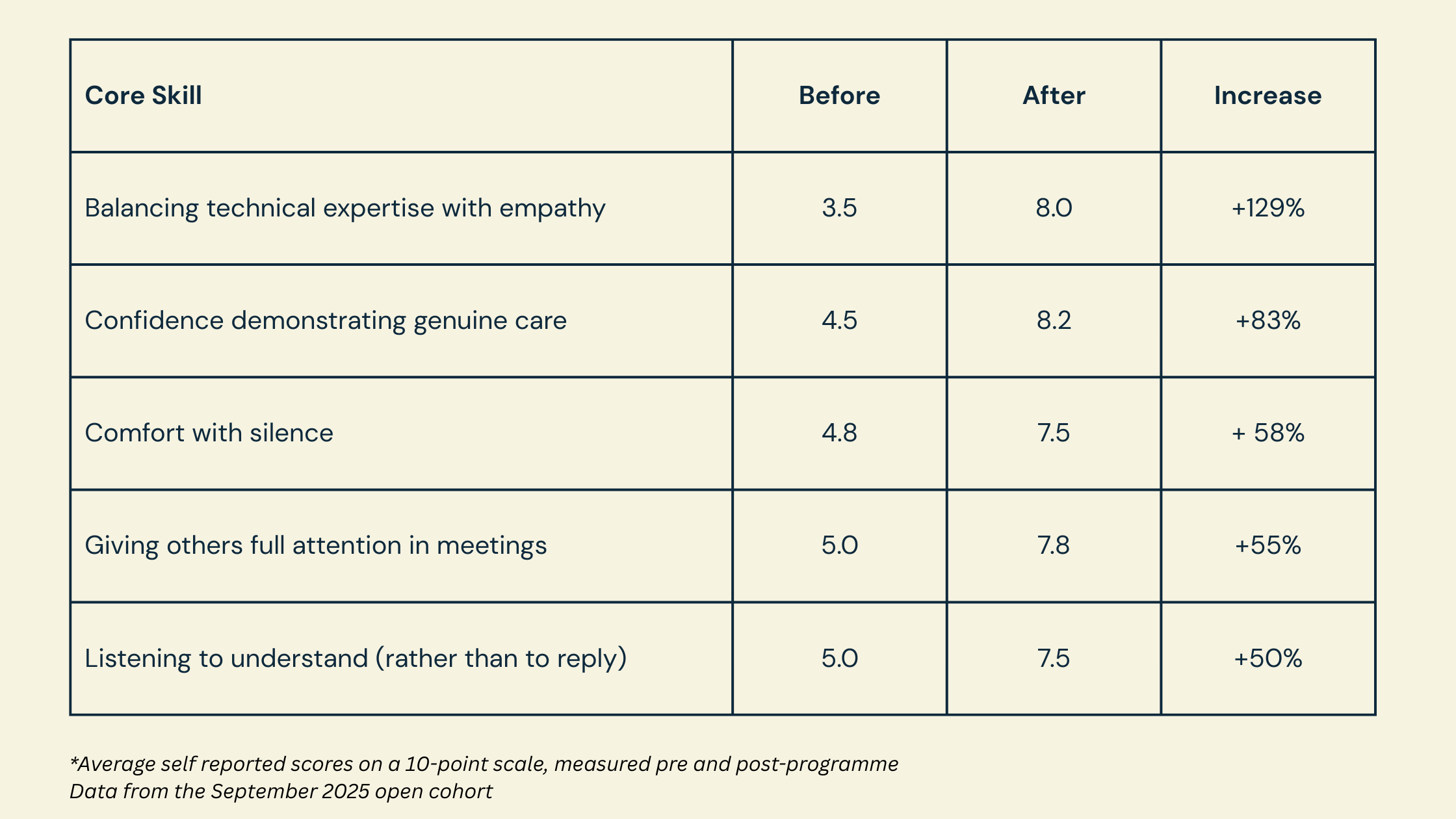
Participants in the Emotional Finance Programme reference significant, measurable shifts in their confidence and competence.
They report transformation and lasting impact.
When asked:
‘How confident are you that you’ll continue applying what you’ve learned and practiced’ Participants responded with 9.5/10.
“To what extent has the programme enhanced your relational skills?”Participants responded with 9.3/10
“Do you feel more confident in your ability to build trust and connection?” Participants responded with 8.8/10
*Average Scores. Data from the September 2025 open cohort.
What participants say…
“I can honestly say it has been one of the most beneficial learning experiences of my training so far.”
James Smith, Verso Wealth Management.
“The impact has been nothing short of profound.”
Dan Haylett, TFP Planning.
“We’ve seen a meaningful uplift in the quality of client interactions, with a more collaborative and thoughtful approach that builds trust and understanding.”
Lee Waters, Barwells Wealth
“The course has had a much bigger impact on me than I expected going into it, and I’m really pleased with what I’ve taken away from it.”
Luke Budd, Scion Financial
Testimonials:
“Having recently completed the Emotional Finance Programme, I can honestly say it has been one of the most beneficial learning experiences of my training so far.
As a trainee financial planner, the course has significantly increased my confidence when speaking with clients as it looks beyond technical knowledge and focuses on the human side of advice of building genuine trust and connection by actively listening, asking open and curious questions and working collaboratively with clients, all of which were areas I had trouble adopting at the start of my career. What I particularly valued was the emphasis on not making assumptions, showing empathy and benevolence, and demonstrating competence without having to rely solely on technical knowledge and jargon.
The course was thoughtfully structured over several months, allowing time to reflect, practise, and embed the learning in real conversations. I have already seen improvements, not only in client meetings, but also in how I listen and communicate with colleagues, friends, and family.
I am genuinely thrilled to be starting my career as a financial planner with this knowledge and skill set. I strongly believe that the theory and practical application taught in the Emotional Finance Programme will become industry standard as advice continues to move towards a more client-centred, relationship-based approach. I would highly recommend this programme to any adviser (aspiring or experienced) who wants to deliver better outcomes for clients while building more meaningful relationships.”
James Smith, Trainee Financial Planner, Verso Wealth Management
”The Programme has been truly transformative for my approach to financial planning. What sets it apart is its focus on the soft skills that are so often overlooked - particularly the art of building trust and forming deeper, more authentic relationships with clients.
Emma’s model provides a strong foundation for understanding the human side of financial planning, and the way she breaks it down makes it easy to put into practice. Throughout the course, I grew in confidence and was encouraged to explore different communication styles, all while staying true to my authentic self.
The impact has been immediate - I’ve already noticed a significant improvement in the strength and depth of my client relationships. Emma’s guidance has not only refined my professional skills but has also made me a more empathetic and adaptable adviser. I would highly recommend her training to anyone who wants to elevate the way they connect with and support their clients”
Lauren Turner, TFP Financial Planning

“Taking part in The Emotional Finance Programme has been a really valuable and insightful experience. It’s encouraged me to think more deeply about how I show up in client conversations and given me practical tools to build stronger, more trusting relationships.
What stood out most for me was the space it gave to slow down and reflect, something we rarely get the chance to do in our day-to-day. The sessions were honest, thought-provoking, and practical, with a great mix of theory, lived experience, and real-world application. I’ve come away feeling more confident and I am holding a dedicated space for clients which focuses on building a relationship intentionally, instead of just being a byproduct of working with someone.
Emma has a brilliant way of making the complex feel accessible and creating an environment where you can learn without pressure. I’d recommend this programme to anyone in financial planning, whether you're at the start of your journey or looking to reconnect with the human side of what we do. It’s helped me grow, and I think it will shape the way I work with clients for years to come.”
Connor Griffiths, TFP Financial Planning

“I just wanted to say a massive thank you for running the Emotional Finance Programme. The course has had a much bigger impact on me than I expected going into it, and I’m really pleased with what I’ve taken away from it.
For me, I already felt myself changing the language I used in the later roleplays and practice calls, so it has been very beneficial for me to take the course.
I feel like what we’ve explored will really help me grow as a financial adviser when I qualify. But equally, what we have learnt has already helped me in my current role and in my non-working life”
Luke Budd, Scion Financial Planning

Not ready to register, but interested in knowing more?
Register your interest to be kept in the loop about upcoming cohorts