

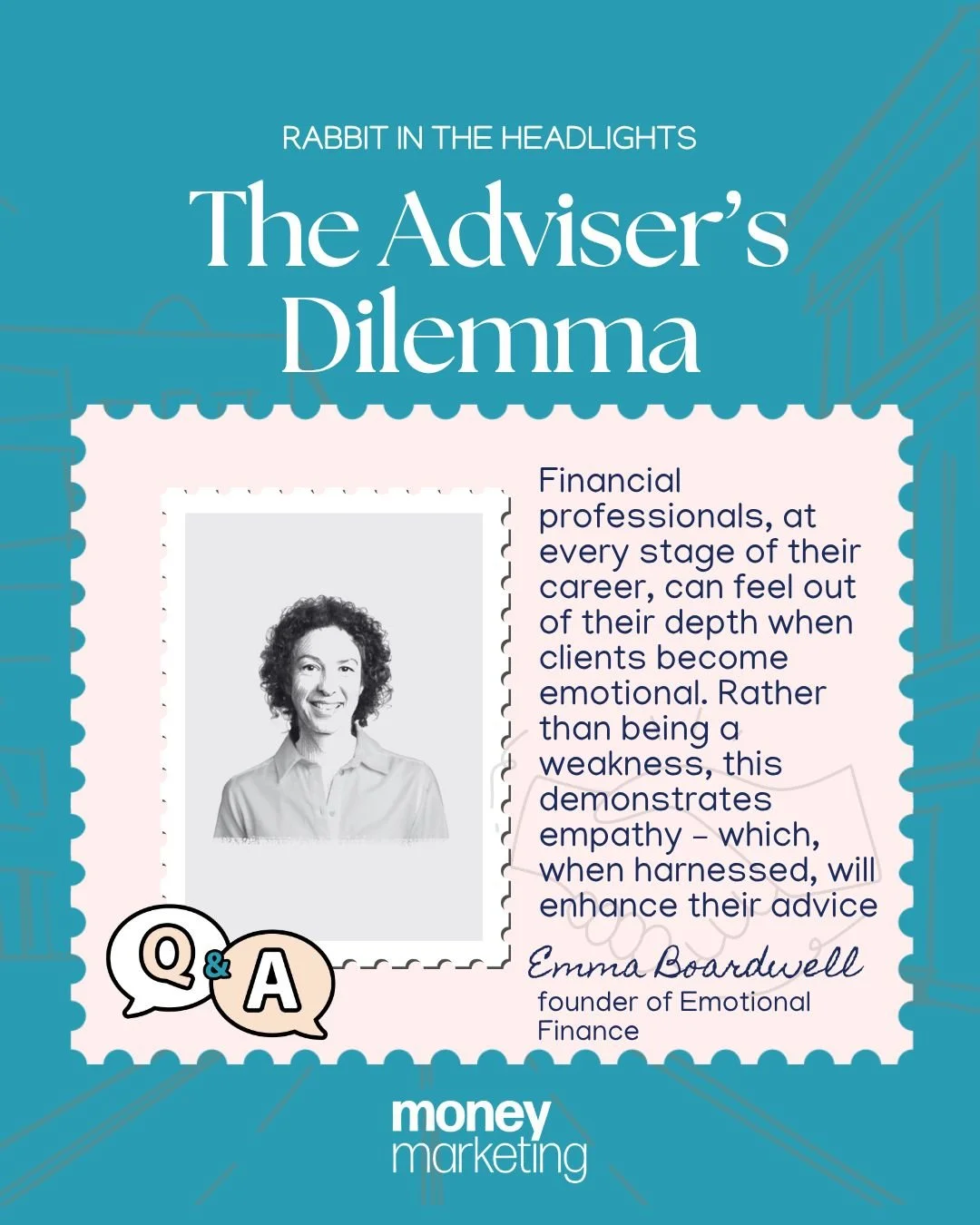
The Adviser’s Dilemma
A monthly column where Emma answers questions about the relationships that matter in financial services.
If you’d like to receive the column straight to your inbox, sign up here
To submit a question anonymously for Emma to answer in a future instalment click here
Dear Emma,
I run a small-ish IFA practice with a team of four planners. I’ve personally always been interested in client psychology, and I believe we have strong values as a firm, with a shared mission to put people before the numbers.
Earlier this year, I sent two members of the team on a listening course, which they both really enjoyed. I’ve noticed the impact it’s had on one of the planners, but I’m still concerned that the other isn’t a particularly good listener. He interrupts frequently, talks over people, including clients, and I sometimes feel he wants to be right more than he wants to learn.
I’d be interested in any advice you have on how best to approach this.
Yours,
Message Not Received
Dear Message Not Received,
Thank you for writing in with this question. It’s really got me thinking and raises some interesting questions about what might be happening beneath the surface of the ‘presenting problem’ you are identifying.
The first thing I’m curious about is your phrase ‘sent them on’ the course. I’m curious how that decision was framed with the planners and how it landed with each of them. Were they involved in the decision? Were they enthusiastic about attending, or is there a possibility they felt that their listening skills were being called into question? I’m wondering if the opportunity to learn felt a bit more like a judgement or possibly even a punishment to them and that this might have influenced how open they were to learning.
Beyond that, I also find myself wondering about what might be getting in the way of your planner (let’s call him Ben) being able to listen well, what might be driving his interrupting and the apparent need to be right.
Could it be that Ben feels he has to demonstrate his authority or prove his worth? That his need to be heard, respected and taken seriously overrides his capacity to listen to others? In this case, the antidote might be to build self confidence and self assuredness first.
Could it be that he struggles to turn off external and internal distractions when he’s with clients? That he’s unable to really tune into his clients and listen because actually he’s not fully present? Good listening requires us to give someone our attention and resist the pull of our own thoughts, distractions and assumptions. The answer here might be to build small pockets of space into his working day: a five-minute walk between meetings, for example, or a habit of writing down the thoughts circling in his head. Even changing his office set-up to reduce distractions could help. The aim is to support his capacity to be present with clients.
Or could it be that he jumps to making assumptions and reaching conclusions too soon? That once he arrives at an answer or a solution he’s moved on to explaining and recommending before he’s checked he fully understands through listening? We can all fall into the trap of thinking we already know the answer because we’ve encountered a similar client or situation before. Developing the habit of approaching each person and situation afresh, with genuine curiosity, can make a real difference. We can never completely set aside our biases, but we can become more aware of them and the influence they have on how we listen.
These are musings. I can’t know what is impacting Ben’s capacity to listen. It might be one of these factors play a part, or all of them or none of them.
Whatever the cause, I’d encourage you to create an opportunity for Ben to reflect on this for himself. There’s a chance here to help him develop greater self-awareness, recognise listening as a genuine area for growth and find his own motivation to improve.
This needs to be approached sensitively and with compassion, of course, rather than making Ben feel singled out or criticised. Coaching, mentoring or a more comprehensive soft-skills development programme could help. You might also consider introducing a team-wide reflective practice group: a space where you can collectively explore your experiences, perhaps try some role plays to be able to reflect and learn from different scenarios - real and imagined - and constructively challenge one another and recognise both your individual strengths and your shared growing edges. Done well, this can help create a culture in which learning is something everyone takes responsibility for, rather than something reserved for those who appear to need it most.
Warmly,
Emma
If you’d like to read previous instalments of The Adviser’s Dilemma, click here.
Send in your dilemma’s anonymously here.
If you want each new instalment sent directly to your inbox please do sign up to my monthly newsletter at the bottom of this page.