
Rabbit in the Headlights

The Adviser’s Dilemma
A monthly column where Emma unpacks real-life situations from across the profession and shares a fresh perspective.
Each month you'll find the latest column published here and also featured in Money Marketing Magazine.
To submit a question anonymously click here
Dear Emma,
I'm relatively new to advising and was recently given the opportunity to lead a client review meeting with one of our long-standing clients. My senior colleague was also there, but I was fronting the meeting.
About halfway through, the client became visibly upset while updating us on her recent divorce and the complexity of the financial implications she was facing. I hadn’t realised how raw it still was for her. I completely froze.
I didn’t know what to say. My mind went blank and I felt like a rabbit in the headlights. I couldn’t even remember what was on the agenda. Thankfully, my colleague stepped in and picked things up, but I barely spoke again for the rest of the meeting. I just didn’t know how to get back into the conversation.
Afterwards, my colleague was very kind about it and just said, "You'll get used to it", but I was so embarrassed.
I keep going over it in my head and wondering what is wrong with me? What if I freeze again next time a client gets upset? How do you know what to do or say when a client cries? Will I ever be a successful adviser if I respond like that?
Yours,
Rabbit in the Headlights
Dear Rabbit in the Headlights,
Firstly, I want to reassure you that what you experienced wasn’t a failure or a flaw on your part. It was your nervous system doing exactly what it’s designed to do.
Distress is contagious, and in this case, you quite literally caught your client’s upset. Freezing - feeling like a rabbit in the headlights, losing your capacity to think, your mind going blank - is a normal and perfectly understandable response. It’s not a professional inadequacy, and it says nothing about your potential or your future success as an adviser.
In fact, your reaction tells me something important: you're capable of real empathy.
The work now is learning how to support yourself in those moments so that your empathy becomes a strength you can use to earn trust, build connection and a shared understanding, rather than something that overwhelms or paralyses you.
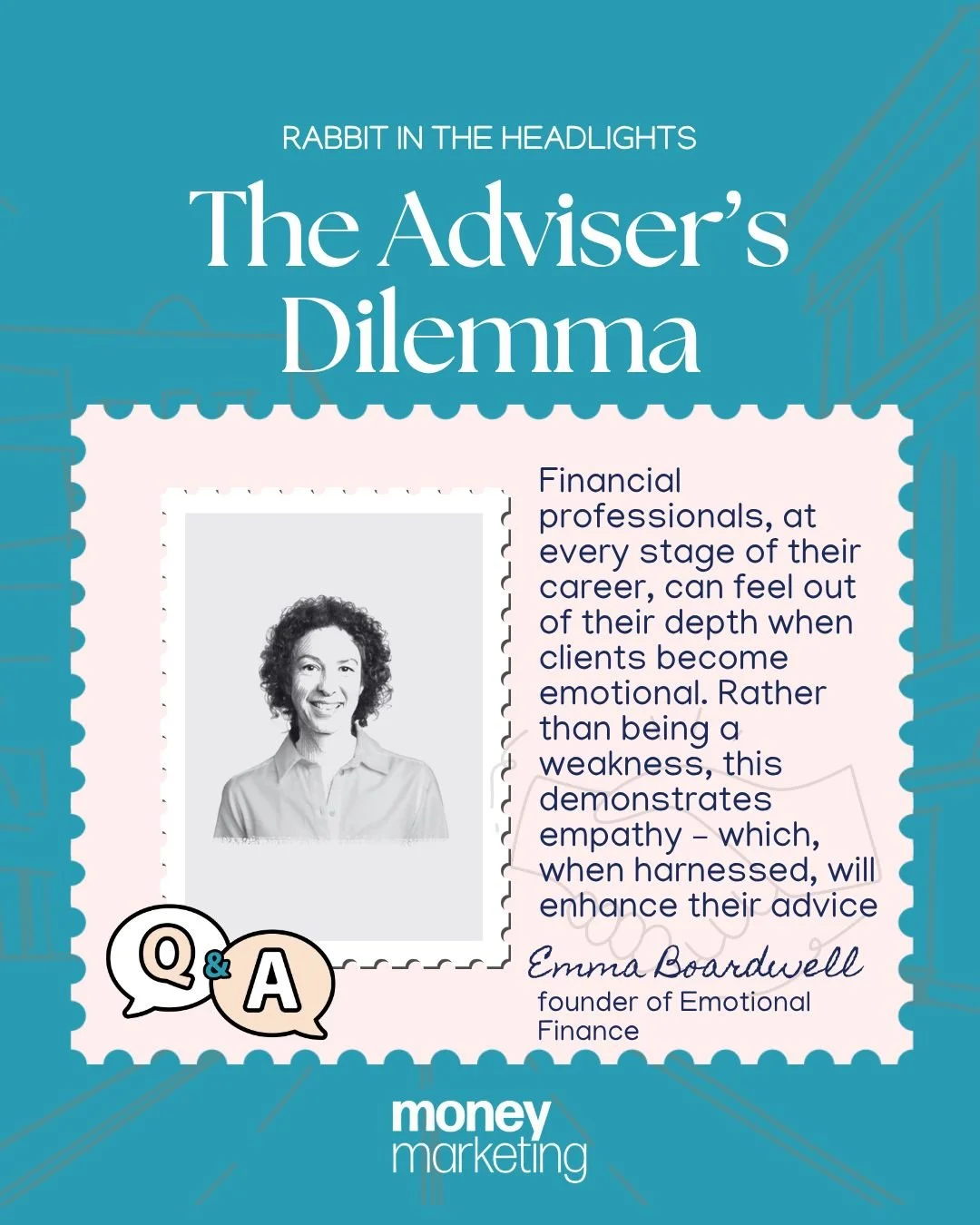
And you are far from alone. Financial professionals at every stage of their careers can feel out of their depth when clients become emotional. That is hardly surprising when navigating emotion is rarely attended to in a professional training.
So, what can you do next time?
Firstly, steady yourself.
Before you try to respond or find the perfect words, prioritise your own nervous system. Feel your feet on the floor or your body in the chair. Slow your breathing. Soften your shoulders. Speak a little more slowly.
You do not need to rush in and fix anything. Your first task is simply to stay present.
Secondly, connect.
Clients who become emotional in meetings often feel they’ve broken some unspoken professional rule. They may apologise, feel embarrassed, or try to brush their feelings away.
Instead of moving past the emotion, acknowledge it. In psychotherapy, we say the antidote to shame is connection. So instead of moving away, or brushing over what’s happened, see if you can lean in. Let them know their feelings are welcome. Your presence and your empathy will do more for securing good outcomes through building a shared understanding and connection with your client, than any technical solution.
Thirdly, collaborate.
Resist the urge to dive straight back into your agenda. Instead, share the responsibility for what comes next.
You might ask:
“Would you like to carry on?”
“Would it help to pause and come back to this another time?”
“What feels possible for you right now?”
The important shift is to stop seeing emotions as a derailment from the ‘real’ work. Sometimes it’s part of the real work. A client’s emotional response may tell you something important about their fears, priorities, relationships or their capacity to make a decision. Staying alongside them can help you understand their lived experience, and as a result offer more aligned and meaningful advice.
This isn’t easy work, Rabbit in the Headlights. We have to embrace the uncertainty and our vulnerability in these moments. There may be times when you don’t know what to say again. But whilst these moments cannot be scripted, they can be intentionally prepared for and practised.
Talk these moments through with colleagues and friends. Notice your own responses in meetings. Reflect on what helps you stay present and what makes you freeze or retreat.
And perhaps you could be a little less hard on yourself. You’re already doing more than you think.
Warmly,
Emma
If you’d like to send us your dilemma or read more from others - head to the submissions page, and/or sign up to the newsletter to be informed when the latest column is published.