

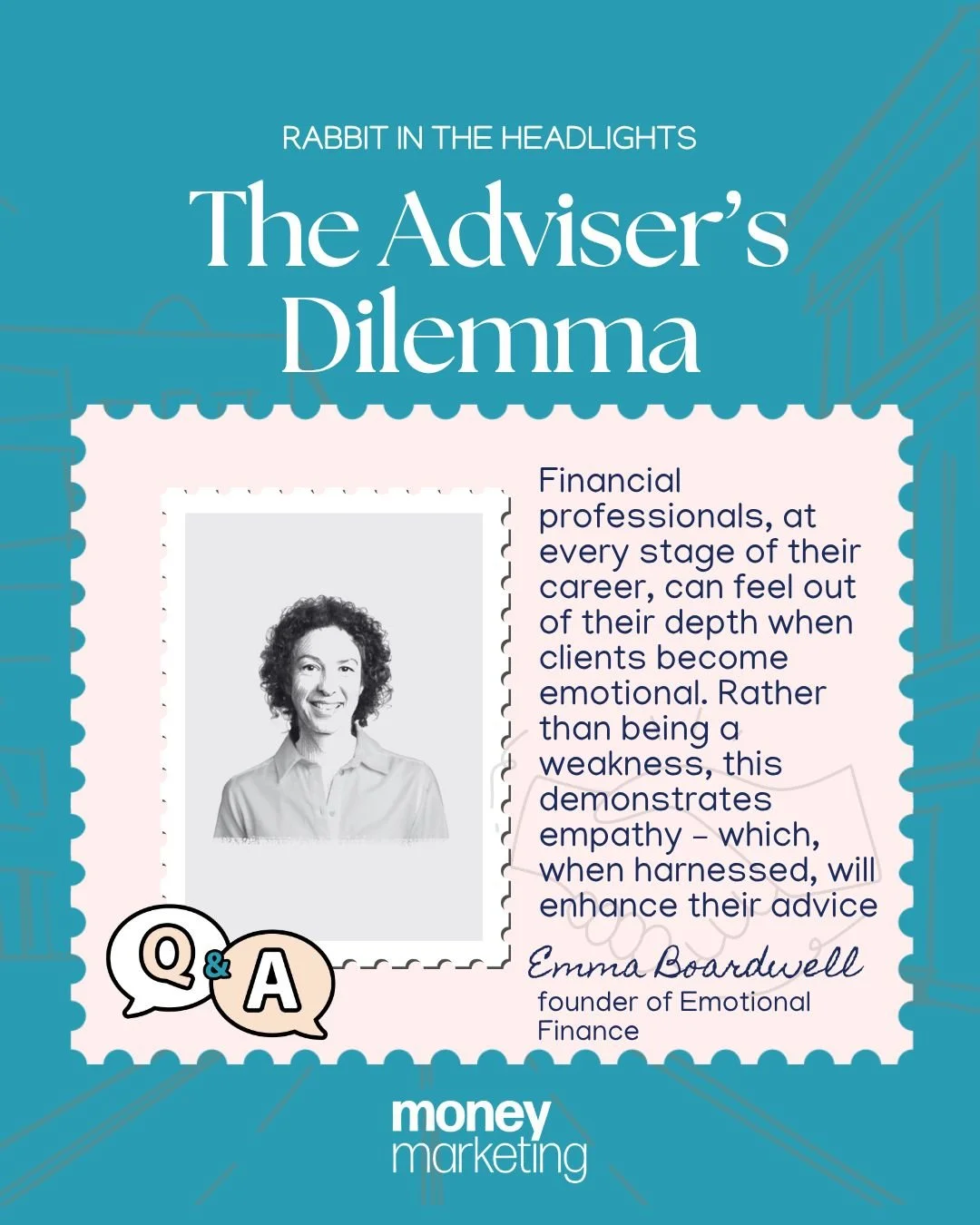
The Adviser’s Dilemma
A monthly column where Emma answers questions about the relationships that matter in financial services.
If you’d like to receive the column straight to your inbox, sign up here
To submit a question anonymously for Emma to answer in a future instalment click here
Dear Emma,
I've become convinced that good financial planning involves understanding far more than a client's financial circumstances. I've read recommended books, attended some training and now I’m trying to ask the powerful questions which have been suggested to me, to get clients thinking more deeply about their lives and their financial wellbeing.
But I'm not sure it's working.
Sometimes I ask one of the classic questions, only to be met with an awkward silence or a superficial answer. I get the impression some clients feel uncomfortable, almost as though I'm prying.
The harder I try to have meaningful conversations, the less natural they seem to feel. Then I get so busy thinking about what to ask next that I'm not sure I'm properly listening.
Should I abandon the deeper questions altogether? Or are there better questions I could ask to help clients connect with their emotions and open up?
Yours,
Questioning Everything
Dear Questioning Everything,
Eeek. I fear I might disappoint you because I'm not going to give you a list of better questions.
Not because questions aren't important. They absolutely are. Some of those so-called powerful questions can open up extraordinary conversations.
But I think the questions are soooooo much more about when, and how than what.
A few thoughts.
First, sometimes asking questions can feel like digging into soil that's still frozen. We're probing, trying to get beneath the surface, hoping to unlock some insight or help someone reach an 'aha' moment.
All with the best intentions, of course.
But the danger is that we inadvertently become a little interrogatory, and the other person closes down or backs away rather than opens up.
When we cultivate the skills of true dialogue – presence, empathy, deep listening, reflecting and responding – we create different conditions. It's more like adding mulch to nourish the soil, planting roots that gradually break it up, and allowing worms to create pockets of space. Gradually, the soil softens and thaws. Conversations gently open up into the spaces created for them.
Second, I wonder whether you're getting a little ahead of your clients.
It's easily done. Planners are trained to solutionise and demonstrate value. So when a client says something interesting, we're often already thinking about where to take the conversation next and what fix to suggest.
But whose agenda are we following? What if instead we stayed alongside our clients, met them where they were at, rather than leading them somewhere we think is best for them. Letting go of the script takes practice. It’s bloody hard to get comfortable with not knowing and near on excruciating to tolerate the discomfort of silence at first. But it’s also essential. Because that’s what allows discovery and meaning making to unfold at the pace clients can digest it.
Third, I'm a little bit sceptical about this profession wide edict that we should all be having meaningful conversations all the time.
Surely that’s up to the client - not us - to decide? I sometimes wonder whether we've started to equate good financial planning with deep emotional disclosure. As though a conversation in which someone cries, shares their innermost fears or has a profound revelation is somehow more valuable than one in which they don't.
I'm not sure it is.
People express emotion differently. Some more visibly and others not. Some in the moment and others later. People experience and process emotion differently too. Some people make sense of their feelings instantly. Others take longer. Years sometimes. And sometimes clients simply want to talk about the numbers with us. They do the emotions elsewhere. Or not at all. Perfectly legitimate.
Finally, there's a difference between looking for emotion and noticing what's already in the room.
When my husband and I had a young child and our circumstances were changing, I felt overwhelmed and disempowered, particularly particularly around whether we could afford childcare and whether to resume my career or take some time to stay at home. I tried to talk to our financial adviser at the time about how I was feeling, but ended up not really feeling heard and the conversation never happened.
I didn't really need him to ask what money meant to me. I barely knew what anything meant at the time. And I certainly didn't need him to ask about my ten-year plan. I was too exhausted to plan for tomorrow. I was already telling him something important. I just needed him to listen and notice.
And that's perhaps the distinction. Questions are enormously helpful, particularly when we're learning. But they're a scaffold, not a script.
The aim isn't to ask the most insightful questions or elicit the deepest emotions. It's to develop the emotional literacy and relational intelligence to notice what's already being expressed, stay curious about what it might mean, and allow that understanding to support better dialogue, decision making and allyship.
Warmly,
Emma
If you’d like to read previous instalments of The Adviser’s Dilemma, click here.
Send in your dilemma’s anonymously here.
If you want each new instalment sent directly to your inbox please do sign up to my monthly newsletter at the bottom of this page.